On a Monday morning, a founder called us with the question we hear more than any other right now: “Are we too early on this AI agent thing?”
The Friday before, his biggest competitor had announced they were handing their entire intake process to AI. He read the post twice, then called us. He wasn’t worried about being early — he was worried about being late.
We call that AI agent trends in business, and it never starts in the engineering room. It starts with a manager who is tired of watching her team move numbers from one spreadsheet into another at 9pm.
Building a custom AI agent is no longer an experiment. For a lot of companies it has already become the default way to automate work processes. Here are the four reasons we keep coming back to after the projects we’ve shipped.
Quick comparison: traditional vs. AI agent workflows
| Factor | Traditional Manual Workflow | AI Agent-Powered Workflow |
|---|---|---|
| Execution Speed | Hours to days per cycle | Milliseconds to seconds (24/7/365) |
| Error Rate | 2% – 8% human fatigue errors | Near-zero variance with consistent guardrails |
| Resource Allocation | Talent trapped in repetitive data entry | Talent focused on strategic decision-making |
| Operational Cost | Scales linearly with headcount | Fixed or predictable pay-per-task model |
| Scalability | Bottlenecked during traffic peaks | Instant, elastic scaling without hiring lag |
1. AI agent trends in business: the cost of waiting
Every technology wave pays the people who move first. Cloud computing did it once. AI agents are doing it again, and this time the curve is steeper.
- Your competitors stopped debating: they use agents to triage customer requests, reconcile invoices, analyze numbers and sync CRM records around the clock — including while your team sleeps.
- Your customers already changed: they expect an answer in seconds, not a ticket number. Manual back-office work cannot hit that bar, no matter how hard the team tries.
Falling behind is rarely a dramatic collapse. It is a quiet loss of market share, a little each month, to teams that are leaner and faster to react.
2. Automate work processes: give people back the work that matters
The biggest waste in any business is paying a skilled person to do copy-paste work.
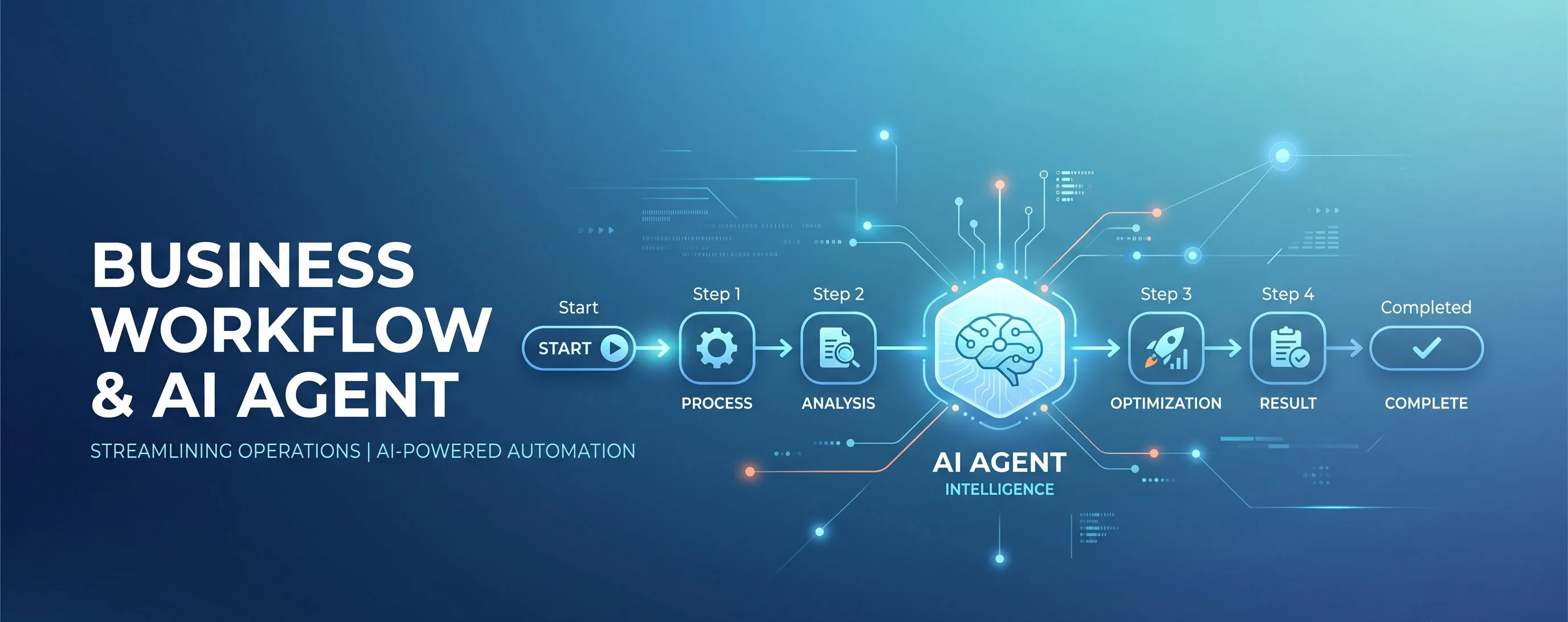
An invoice used to travel through five steps — collect, copy, format, verify, report — and now an agent takes that whole chain and hands back exactly one job: approve.
- Delegate the drudgery: invoice extraction, cross-platform sync, lead enrichment and status reporting all go to the agent.
- Your people change roles: from “person who operates tools” to “person who supervises them”. They spend their day on customers, quality, and the decisions that actually need a human brain.
When nobody has to re-type what a colleague just typed, the whole company gets faster without anyone staying late.
3. Cut costs and compress turnaround times
Every owner looks at margin first. Agents touch it in two places, and both are easy to measure:
- Cost: smaller backlogs, fewer manual clean-up fixes, and far less overtime spent catching up.
- Time: work that used to bounce between departments — vendor onboarding, the weekly report — used to take days and now takes seconds.
The second one is what surprises clients most. Being a day faster than everyone else is something customers remember; saving a few dollars is not.
4. Why custom AI agents beat off-the-shelf bots
An off-the-shelf chat tool does not know where your internal data lives, how your APIs are called, or what your security process actually requires.
A custom-built AI agent wires straight into what you already run — CRM, ERP, databases, Slack, email:
- Context-aware: it uses your documentation and your business data, not generic knowledge from the internet.
- Action-oriented: it fires webhooks, updates records, dispatches alerts. It finishes the job instead of handing you another paragraph to action yourself.
- Secure by design: clear permissions, a record of who did what, and no internal data drifting outside your control.
This is why most of the companies we work with spend a few weeks on an off-the-shelf bot, then come back to build their own.
Frequently asked questions
What is the difference between a chatbot and an AI agent?
A chatbot replies from a script. An AI agent reads the context, splits the work into steps, calls tools and APIs, and finishes the whole workflow without someone clicking at every stage.
How fast can we expect ROI?
Most companies see positive ROI within 30 to 90 days, starting with high-frequency work: support ticket triage, document handling, or lead qualification.
Will AI agents replace our workforce?
No. Agents take the repetitive part so people can move into supervision, strategy and deeper customer work. It’s an assistant, not a replacement.
The Bottom Line
If that founder calls back, our answer is the same: the real question isn’t “are we too early?” — it’s “which process do we start with?” Automating work processes sounds like a company-wide project, but it always starts small: one repetitive task, one person willing to let the agent try.
Pick that task, measure it again in three months, then expand. You don’t have to bet everything on one rollout.
Curious what an agent could do for your workflows? Talk to our team — we’ll map it out with you before writing a line of code.